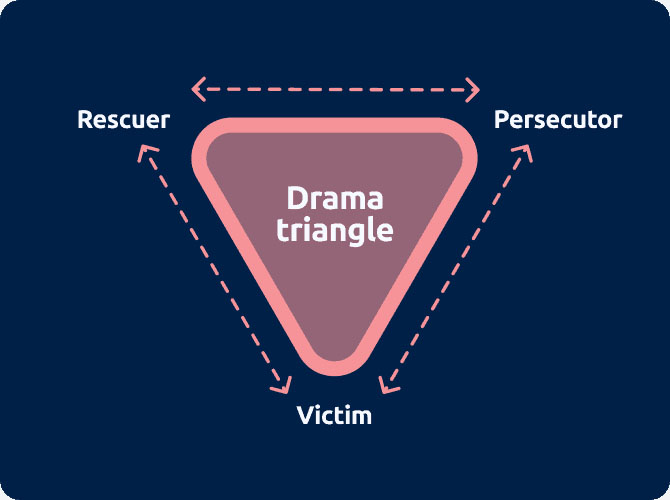
Remember the Johnsons who were caught in the Drama Triangle? Actually, we all know the Johnsons a little too well… Mr Johnson believed he was the family’s Rescuer, but they experienced him as the Persecutor. Mrs Johnson jumped to the children’s defence, becoming his Victim in the process. Susie tried to keep the peace, inadvertently playing Rescuer herself.
Every one of them was stuck playing a role in relation to the others – and the drama sustained itself precisely because the roles kept shifting from one character to another.
So how do you actually get out of it?
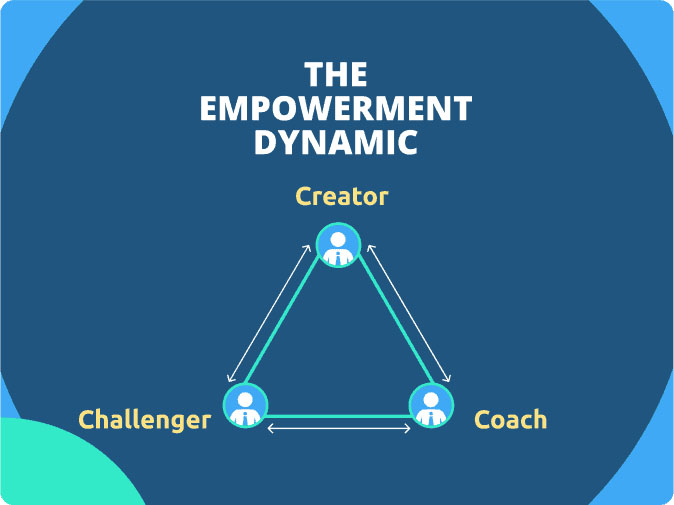
Well, since the drama is sustained by taking on various roles that establish a Drama Dynamic, it is possible to take on a different set of roles that create an Empowerment Dynamic. Each of these roles is an alternative to the roles in the Drama Triangle and sets up an opposing model that offers a new language, new ways of thinking and a new and different way of being. This approach offers fresh perspectives and options for responding differently… allowing us to create “healthy” relationship dynamics.
This approach, called The Empowerment Dynamic (TED), created by David Emerald and Donna Zajonc, provides an answer to resolving the disempowering dynamics of the Drama Triangle.
The 3 Roles of The Empowerment Dynamic
The Empowerment Dynamic “flips”:
- The Victim into a Creator
- The Persecutor into a Challenger
- The Rescuer into a Coach
The Empowerment Dynamic (TED) is the complete opposite of the Drama Triangle.
The interdependence between the roles, rather than being unhealthy scripts that keep the characters stuck in their roles, introduces healthy scripts that invite the characters to embrace a positive dynamic.
TED introduces a positive approach to life’s challenges.
When you faithfully interact from these new scripts of Challenger or Coach, you can help the Victim interact from a Creator script of sufficiency and personal agency instead of a Victim script of weakness and deficiency.
Each of these roles has three core beliefs that help them maintain their script.
Creator, Challenger or Coach – Which role are you?
The Creator
Creators see themselves through a lens of possibility (rather than the weak deficiency identity of the Victim).
They take charge of their lives. And believe in their own potential.
Where the Victim prefers to look back, re-telling the deficiency stories of their past, the Creator looks forward, taking an optimistic approach to life.
A Creator role has three core beliefs:
- I am sufficient, whole and complete
- I am responsible for choosing my responses to life
- I can focus on learning and improving, even when faced with struggles and setbacks
Guiding Growth Question: If I had free choice in this matter, what options might I create?
Creators are better able to choose how they want to react in life. They know they are not at the mercy of others’ power over them. Where the Victim says “I can’t”, the Creator says “I can”.
They believe they can control their own destiny, with the empowering information they have.
They take responsibility and spend less energy trying to change situations over which they have no control.
They don’t accept situations in defeat, they accept situations with the knowledge that they can work with what presents itself to get where they want to be.
Creators adapt most effectively. They see options in every situation.
Operating as a Creator doesn’t mean the weather will always be good. But Creators are better able to navigate life effectively with the help of the other two roles.
The Coach
The Coach takes quite a different tack when dealing with the Creator, compared to the Rescuer’s approach to the Victim. One of the main differences is listening, instead of telling.
The Coach adopts an approach that asks “How are you/we going to create what you/we want?”
Coaches listen; they are supportive partners in the process.
This is completely opposite to the Rescuer’s approach to the Victim, whose favourite line is “I know best!”. The Rescuer often intervenes without even being asked.
The Coach doesn’t force solutions on the Creator. The Coach knows the Creator can find their own solution, with a little help, perhaps.
If a Coach refrains from jumping in and taking control, it empowers the other person’s creativity. They then become more involved in finding the solution.
The Coach empowers the Victim to see their own potential in a situation and so calls the Victim into another dynamic that is more empowering for the Victim. Coaches turn Victims into Creators.
A Coach role has three core beliefs:
- I have faith in the wisdom that lies within
- I trust the discovery process
- I believe in leaving the power with others as they clarify what they want
Guiding Growth Question: What is the opportunity here, and what can I ask to inspire insight?
A Coach helps facilitate a space in which the Creator can find insights.
“With this faith, a Coach allows time for the individual’s unique learning process to unfold, while holding them as ultimately whole and complete.”
A Coach trusts that the process will uncover solutions in time, as and when the Creator is ready for them.
Rather than striving to fix the Victim, they wait, and trust that the person is a Creator.
They are ready to celebrate progress in the Creator – without the classic Rescuer’s “I know best” approach.
There is a willingness to take the time to understand and find out what’s really going on.
When it becomes clear what needs to happen, a Coach has the ability to help the Creator find their own way forward.
With an inherent intuition, a Coach can play a really helpful role in anticipating obstacles or barriers as they arise to help the Creator navigate them more effectively.
A Coach understands that as there is more clarity, so deeper wisdom generates the energy needed for action.
When Creators are empowered to discover their own way forward, empowered to chart their own path, they develop more creativity for innovative solutions.
The Coach is like a midwife to help birth those “aha” moments in the Creator. And those breakthroughs create a drive and desire for action.
The Coaches help to adjust the sails in the boat of the creator when the winds change. But they don’t just take over as captain of the boat. And, as a Coach refrains from jumping in and taking control, it empowers the other person to be more creative, to be involved in the solution process. Coaches know that if they default into a Rescuer role, it will be harder for the Victim to see their own potential in the situation.
By taking on the role of coach, the victim is elevated into a creator.
The Challenger
Challengers also have the Creator’s best interests at heart, but, unlike Coaches, they are more likely to speak their mind.
Challengers are committed to a certain perspective and value.
They see themselves as truth-tellers and sometimes say what’s unpopular, but in a way that is very different from how Persecutors tend to intervene.
Challengers focus on the issue, not the person.
So, to use the sailing metaphor, they say “The sails aren’t right for this wind”, not, “You don’t know how to sail”… or maybe “I don’t think that’s the right direction to be going” not “you’re an idiot for going there”.
So when they speak the truth, it is safe, and this often sparks learning and growth, which are very important for Creators to reach their potential.
Ultimately, the involvement of the Challenger inspires Creators to “reach for the highest good.”
A Challenger role has three core beliefs:
- Life is about learning and growth – even in the face of “not knowing”
- Given that life is ever-changing and uncertain, I rest in the confidence and conviction of my values
- I tell the truth about current reality, without blame or judgement
Guiding Growth Question: Can I speak my truth in a way that is palatable for others and let go of the outcome of my feedback?
Challengers ask themselves, and others: “Given the situation, what can we learn or gain here?”
Like Coaches, they also trust the process. Sometimes they provoke a response, or nudge people to act, to learn and grow.
In the Drama Triangle, Persecutors try to control the chaos, but in the Empowerment Dynamic, a Challenger is comfortable in uncertainty, knowing that they don’t know everything.
For Challengers, it’s all part of the learning process.
The second belief, “I rest in the confidence and conviction of my values”, is really at the heart of the “truth” that a Challenger speaks.
Challengers have a lot of integrity. Staying true to their values and keeping their word is a high priority for Challengers.
For them, it’s not about being right, but rather, by taking a stand for what they believe, often amidst chaos and change, they challenge and inspire others to take a stand too.
The Key Difference Between Challengers and Persecutors
The key difference between Challengers and Persecutors is that Challengers state the truth as they see it, without blame or judgement.
Challengers see reality as it is, without judging the person. They don’t take the Persecutor’s “one-up” approach to the Creator – blaming, accusing and belittling.
The issue is not the person.
This doesn’t mean that the Challenger isn’t willing to be vulnerable.
A Persecutor is fearful and desperately trying to hide his own failure and hypocrisy; this makes him attack and deflect attention to protect a perfect façade.
But a Challenger has nothing to hide. They are not pretending to be perfect. They are simply calling everyone to the truth.
The Empowerment Dynamic: Roles at a Glance
| Dimension | Creator | Challenger | Coach |
|---|---|---|---|
| Shift From | Victim | Persecutor | Rescuer |
| Inner Script | "I am responsible for choosing my responses and creating what I want." | "I tell the truth about reality without blame or judgment." | "I have faith in your inner wisdom to find your own path." |
| Core Focus | Possibility, growth, and personal agency. | Learning, truth-telling, and living by values. | Facilitating insight, support, and empowerment. |
| Key Behavior | Takes responsibility, focuses on options, and acts. | Addresses issues rather than attacking people. | Listens, asks inspiring questions, and refrains from taking over. |
| Relational Impact | Reclaims personal power and drives positive action. | Inspires growth and accountability without judgment. | Builds self-reliance and empowers creative solutions. |
You CAN Stop Playing The Victim
In the Drama Triangle, all three roles are actually victims of that dysfunctional dynamic. Because, ultimately, Rescuers and Persecutors end up as Victims too.
So, for any of those unhealthy roles to shift into new empowering roles, they all need to grow and learn, they all need to become Creators.
And they can all help each other to get there. Each script in the Empowerment Dynamic calls out the best in the other roles.
Just as drama happens when roles switch from Persecutor to Victim to Rescuer, personal growth and strengthened relationships happen when we can switch between the different roles in the Empowerment Dynamic.
To stop playing the Victim so that you can get out of the Drama Triangle means starting to see yourself as a Creator, with the help of those around you.
But it takes hard work to move from the unhealthy co-dependency of the Drama Triangle into the interdependence of the Empowerment Dynamic.
Getting there takes trust, vulnerability and compassion… It takes Emotional Intelligence.
Growth is About Allowing Yourself to be Vulnerable
Trust and compassion build in the face of vulnerability.
Brené Brown, a well-known shame researcher and author, explains that our purpose in life is connection with others.
Connection gives us meaning. In contrast to shame, which unravels connection.
Shame says “I am not good enough, thin enough, … rich/tall/funny/pretty/clever … enough.” So, in order not to feel the shame of “not being enough,” we hide our true selves from each other.
Shame breeds fear, and living with shame prevents us from truly connecting with people.
We fear that they too will find out we are not enough. So we put up walls and hide our true selves. But when we do have a sense of belonging, we experience courage, compassion and connection.
Vulnerability is the catalyst for belonging, courage, compassion and connection.
Without vulnerability, we will never truly experience belonging, courage, compassion, or connection. How could we? We haven’t shared our true selves.
Where Trust And Compassion Come In
Vulnerability helps us connect through trust and compassion.
When others are brave enough to be vulnerable, we accept them! With open arms. Why? Because we resonate. We know how they feel.
So our compassion grows.
And when they trust us enough to be authentic and show us their true selves, we are moved. We admire them.
Can you see the double standard we have?
We see our own weaknesses through the lens of shame, yet we are drawn to the vulnerability of others.
And it is through experiencing their vulnerability that our trust and compassion for them grows. If we can bring ourselves to be vulnerable, it will help others trust us and grow their compassion for us. But the trust and compassion necessary to help the other characters in the Drama Triangle pivot into their new empowerment roles, depend on this vulnerability.
Vulnerability is hugely powerful. But…
Before we mistakenly think vulnerability is the silver bullet, there is a cautionary note:
While vulnerability does breed trust and compassion, there needs to be at least some trust to work with before you uncover your deepest, darkest self.
No one is suggesting you walk up to strangers (or colleagues) and tell them all about your insecurities.
“Vulnerability is based on mutuality and requires boundaries and trust”.
Vulnerability is safe when people have earned the right to see us. And then trust, the by-product of vulnerability, will grow. But you should have a foundation of trust first, no matter how small, on which you can be vulnerable.
Placing undeserved trust in someone, which isn’t met with appropriate compassion, may lead you to be vulnerable in ways that end up hurting you.
If people have betrayed you in the past, be careful.
It doesn’t mean those relationships can’t heal and become healthy, but it does require wisdom to get there.
And, sometimes, in extreme cases, people who aren’t able to relinquish their own unhealthy roles will keep trying to pull you back into the drama again.
Sometimes, the cost of staying in damaging relationships is too high, and it’s wiser to walk away, or put boundaries in place to protect yourself.
From One Relationship to a Whole Team
Everything above holds just as true at work as it does at home – and there’s a metaphor that makes the shift easier to picture: sailing.
In a sailboat, the ropes, or lines, adjust and orient the shape of the sails, helping to position them most effectively to respond to the wind.
Achieving the best shape of the sail is done by adjusting the tension in the lines. Sometimes you pull them in, sometimes you let them out. Line tension is what holds the sail in the most appropriate shape for the weather conditions.
If you look at the shape of the sails, they form a triangle (get it?).
And when the bottom points of the sail are adjusted appropriately, with the right tension in the lines, the boat is empowered to sail more effectively. Now, when it comes to relationships, that’s what the new roles of TED can accomplish.
Through appropriate tension in the “friendshipliness”, or friend-ship-line(s) (can you feel the dad joke trying to come through??), we can change the orientation and shape of the sail – empowering you to sail your boat, or your life, most effectively. You can respond suitably to whatever weather you face.
These new roles and scripts require trust and compassion to play out appropriately. Getting the tension right between trust and compassion is important, whether you’re one person navigating a relationship, or a whole team navigating a project.
As each member of a team moves from the scripts dictated by the Drama Triangle and begins to embrace the healthy roles outlined in The Empowerment Dynamic, the team will start to experience increased levels of Psychological Safety, and the benefits of that Psychological Safety will include healthier team dynamics and higher levels of innovation, collaboration and creativity.
Further Reading
- What is Emotional Intelligence?
- Emerald, D. & Zajonc, D. (2019). The Power of TED* (*The Empowerment Dynamic). Polaris.