
The Mygrow approach to development

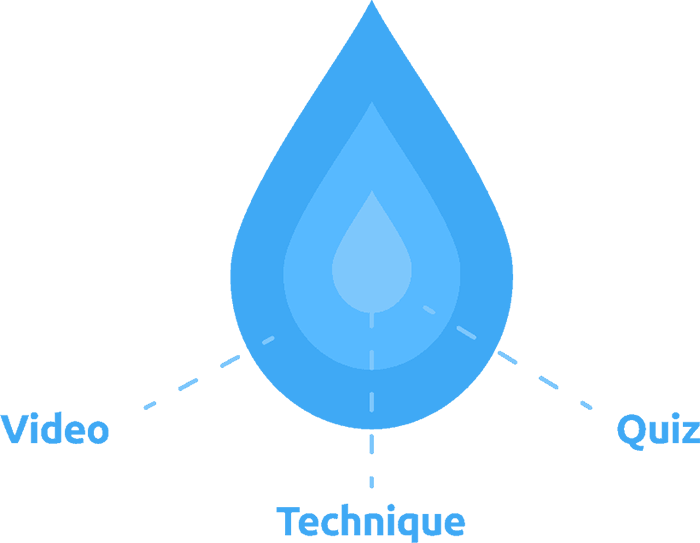
The Mygrow Droplet – 15 minutes a day

The video

To equip you with the knowledge that you need to deeply understand the psychological elements needed to develop effectively.

The video

To equip you with the knowledge that you need to deeply understand the psychological elements needed to develop effectively.

The video

To equip you with the knowledge that you need to deeply understand the psychological elements needed to develop effectively.

If you have done any Emotional Intelligence (EQ) or ‘soft skills’ development before, you might find the Mygrow approach a little different.

Mygrow is based on a methodology that incorporates ‘microlearning’ and day-by-day progress to facilitate consistent repetition and technique implementation over time. The development journey is broken down into small, bite-size chunks we call ‘droplets’. The droplets are made up of a video, quiz, and then an EQ exercise which we call a ‘technique’. This is something you do or implement. On average, a droplet takes you about 15 minutes to complete.

Droplets vs. fire hydrants

Our ‘droplet’ methodology can be contrasted with the ‘fire hydrant’ approach to learning. This is your more traditional training setup in which you attend a training workshop where you are ‘sprayed with information’ and hope something sticks. Or alternatively a short course that you do in a few days that gives you knowledge and a certificate, but where you don’t really know how to apply what you’ve learned properly. These knowledge based approaches are a bit like trying to drink from a fire hydrant. So much information gets thrown at you but a small amount is actually absorbed. The following week you often can’t remember the snacks from the workshop, let alone the content you were taught.

The problem with the fire hydrant approach is that it doesn’t really change you in the long term, because it is focused on giving you information about EQ, rather than helping you actually develop EQ. At Mygrow we believe information alone is insufficient in fostering change. It’s important, but it’s just one part of the story of development. An in-house analogy we use is that you can read guitar magazines all day long, but that won’t help you play the guitar, unless you practise, repeatedly over long periods of time.

The Mygrow droplet combines the benefits of microlearning, a day-by-day restricted approach that means you can only do one droplet a day, and scientifically proven techniques that you do on a repeated basis.

A rigorous methodology

Microlearning:

Bite-sized

  • Convenient – anytime, anywhere
  • Time-efficient
  • Easy-to-digest content
  • Reduces cognitive overload
  • Fits into “downtime” gaps
  • Makes learning easier

Day-by-day:

Daily

  • Helps in habit formation
  • Improves knowledge retention
  • Promotes a development lifestyle
  • Strengthens discipline
  • Daily application of learning
  • Prevents binge learning

Repetitive techniques:

The power of repetition

  • Scientifically effective for change
  • Forming new neural pathways
  • Development is practical
  • Sustained development
  • Real life application
  • Long term behaviour change

Mygrow uses a micro-learning methodology, which means you do daily learning portions of 15 minutes a day over long periods of time. These bite-sized portions are convenient as you are able to do them anytime, anywhere, on any device with an internet connection. This approach is time-efficient in that you do a little bit at a time, which allows you to integrate your learning into your daily schedule. This makes the information easy to digest and reduces the cognitive overload that can occur if, for example, you read a whole course in a few hours. The concepts learned are also clustered in a way that makes knowledge retention more effective.

You can only do one droplet a day. You can’t binge Mygrow, you can’t procrastinate and make it all up at the last minute. This helps in habit formation, improves your knowledge retention and enables you to integrate the learning experience into your life. You become a lifelong learner, rather than a sporadic one. It might be frustrating that you can’t keep going from one video to the next, but Mygrow isn’t your latest series on Netflix. In fact, the daily practice of Mygrow will strengthen your discipline, itself an EQ skill, and make developing yourself a daily habit.

If you want to make the most of Mygrow, make it a habit. Our ‘droplet a day’ approach enables this. A habit is an automatic behavioural pattern in response to a cue. It is the result of repeating a behaviour, in the same context, again and again. Repetition strengthens the association between the context and the action – forming a habit (Lally & Gardner, 2010).

You may have heard that it takes 21 days to form a habit. But this is not in line with research. Dr Philippa Lally, who specialises in the psychology of habit formation, found that it takes an average of 66 days – and can range from 18 days for some people to 254 days for others- for a habit to be formed (Lally & Gardner, 2010). So it may take hard work and conscious effort in the beginning to make a habit out of your Mygrow droplets, but once you do it, you are on your way to life-changing development.

The concept of neuroplasticity indicates that our brains are constantly being reshaped and moulded throughout our lives by both our experiences and our thoughts. Where it used to be believed that our brains were relatively fixed after childhood, scientific advances have now clearly shown that our brains can and do change throughout our lives.

Donald Hebb (1949), a neuropsychologist, spent his life studying the neurological basis of learning. He found that when specific nerve cells are stimulated persistently or repeatedly, this tends to cause an association between them and other neurons that adds to the stability of that association. This principle is often summarised like this: “neurons that fire together, wire together”.

An analogy for this is to think of your brain like a grass field. If you walk along the same route on that field over and over again, eventually a pathway will form. Likewise, if you choose another pathway and force yourself to keep walking along that new pathway, eventually the old pathway will become overgrown and after a long time of not using it anymore, it may look as if there was never a pathway there in the first place.

In a similar way, the focus of our awareness determines which brain networks are strengthened, weakened, or even lost. So if we practise anxiety, anger or negativity, we strengthen these networks. But if we practise joy, calmness and positivity, we strengthen these networks too. In this sense, when it comes to our brain, what we practise is what we become.

The key takeaway from this is that we can change the neural pathways in our brains and strengthen those that we want to keep, while weakening those that we want to lose. The way to do this is through consistent repetition over long periods of time, and the droplet methodology on Mygrow is designed to facilitate this.

Exercises backed by science

Development, growth and change are things many of us hunger for. However, this takes work, effort and time. Always. So Mygrow is more like a gym than online learning. You can watch fitness videos all day long, but it won’t give you a six-pack. You have to exercise properly. You can watch Mygrow videos all day too, but it won’t improve your EQ. You have to do the techniques properly. The same analogy applies to anything you want to learn to do well – from learning a musical instrument to mastering a hobby. It’s not necessarily what you know that changes you, it’s what you do with what you know.

EQ skills develop by regularly implementing specific techniques that work to change the neurological wiring around the emotional centres of the brain. This rewiring takes time and is done effectively through long-term repetitive training interventions. Each technique you do on Mygrow is thoroughly researched and backed by science. Founded in Positive Psychology, the techniques are rigorous and empirically sound, ensuring that the exercises you repeat over time really are going to develop you. To continue with the gym analogy, if you do the wrong exercises over time, you won’t get stronger. It’s no use doing push-ups if you are trying to strengthen your calf muscles. In the same way, it’s imperative that the techniques you do to grow and improve yourself are rigorous and targeted. Mygrow can be trusted to do this.

Change happens through repetitive techniques over time. That’s why Mygrow has been built to facilitate your development one droplet at a time.

References
Hebb, D. (1949). The Organization of behaviour – a neuropsychological theory. New York: Wiley and Sons.
Lally, P. & Gardner, B. (2010). Promoting habit formation. Health Psychology Review, 7(1), S137-S158.

A detailed content overview

Learning outcomes

The Mygrow platform develops EQ – a set of skills that makes a person great at managing themselves and interacting with others.

  • Each Mygrow module is made up of 20-30 droplets (a daily video, quiz, and technique)
  • The Fundamentals content progresses according to the Bar-On EQ-i 2.0 Model
  • Reasonable engagement rates are between 3-5 droplets per week

Fundamentals 101

The first course on Mygrow covers one cycle around the EQ-i 2.0 wheel, giving an overview of each competency grouping. Below is an outline of the knowledge and skills that are gained through this first “course”.

Bootcamp introduces some of the core concepts used on the Mygrow journey. It also provides a clear understanding of what EQ is, and how to develop it properly. The following conceptual aspects are covered:

  • The difference between Emotional Intelligence and Cognitive Intelligence
  • The power of the mind
  • The difference between the conscious and subconscious mind
  • The fundamentals of neuroscience
  • A brief overview of the theories of emotion
  • The connection between the body and the mind
  • How to implement the “Three Good Things” technique

Skills Developed: Positivity | Gratitude | Optimism

It’s essential to grow in self-awareness to develop EQ properly. Self-awareness can occur as a result of one’s own reflections and through the input of others. This module focuses on increasing self-awareness in relation to the different aspects of EQ and guides the user through their personal EQ 360 assessment. The following conceptual aspects are covered:

  • Psychometric assessment feedback
  • The importance of self-awareness as a foundation for EQ
  • The Johari Window as a self-awareness tool
  • How to reduce blind spots
  • Receiving feedback from others
  • Overview of Self-Perception, Self-Expression, Interpersonal, Decision-Making, and Stress Management
  • How to implement the “Using Signature Strengths” technique

Skills Developed: Inviting feedback | Self-confidence | Objective self-view

This module delves into self-perception, which centres on how one perceives oneself. It also looks at Self-Regard, Self-Actualisation, and Emotional Self-Awareness (specific skills related to Self-Perception). The following conceptual aspects are covered:

  • Learned Helplessness
  • How self-perception develops over time
  • Cognitive Dissonance theory
  • Locus of Control theory
  • The competencies of Self-Regard, Self-Actualisation, and Emotional Self-Awareness
  • The Elastic Band technique
  • How to implement the “Affirming Statements” technique

Skills Developed: Self-esteem | Seeing strengths in others | Trigger reduction

Self-expression involves how appropriately one is able to express oneself, assert oneself, and act independently of others. This module equips a person to take daily control of the way they express their emotions. The following conceptual aspects are covered:

  • Albert Ellis and the history of Rational Emotive Behavioural Therapy (REBT)
  • The link between thoughts and emotions
  • The chemistry and neurology of emotions
  • Top-Down versus Bottom-Up thinking
  • Amygdala hijacking
  • The individual competencies of Self-Expression, Independence, and Assertiveness
  • How to implement the “ABCDE” technique

Skills Developed: Emotional control | Stress Management | Self-Management

Relating to others is critical to who we are. This module focuses on developing and maintaining mutually satisfying relationships based on trust and compassion. It also explores why we need relationships and covers the complexity of interpersonal dynamics. The following conceptual aspects are covered:

  • Stephen Covey’s theory of Relational Maturity
  • Transactional Analysis
  • How we are wired neurologically to connect with others
  • Why we need people
  • Toxic versus supportive relationships
  • The competencies of Interpersonal Relationships, Empathy, and Self-Expression
  • How to implement the “Giving Praise” technique

Skills Developed: Motivating others | Affirming others | Seeing the best in others

The Decision-Making module focuses on the skill of making good decisions by accurately recognising and understanding the emotions one associates with different decisions. It also looks at how impulse control and problem solving are vital skills for making successful decisions. The following conceptual aspects are covered:

  • The history of research on Decision-Making
  • “Wants” versus “Shoulds” conflict
  • Biases and intuition
  • Challenges of making good decisions
  • Decision-making styles
  • The competencies of Problem Solving, Reality Testing, and Impulse Control
  • How to implement the “Pause, Consider, Emotions” technique

Skills Developed: Reality testing | Impulse control | Functional alternatives

Life is stressful, and to flourish, it is important to be able to manage this. Stress Management is made up of three main skills: flexibility, stress tolerance, and optimism. In short, this module asks the fundamental question, “How effectively do you cope with stress?” The following conceptual aspects are covered:

  • How stress impacts the body and brain
  • The history of the concept of stress
  • How the heart and the brain are connected
  • Different types of coping strategies for stress
  • Burnout
  • The individual competencies of Flexibility, Stress Tolerance, and Optimism
  • How to implement the “Heart Coherence” technique

Skills Developed: Managing physiology | Heart coherence | Positive emotion

Fundamentals 201

The next course on Mygrow is the second cycle around the EQ-i 2.0 wheel. This journey takes a deeper look at the first skill in each competency grouping and applies these skills to more specific aspects of life.

This is the second Self-Awareness module and serves as a recap of the first seven modules. It is an overview of what has been covered previously, while assessing one’s growth between the first and second EQ assessments. Users are given the chance to reflect on their experience of F101, and the following conceptual aspects are covered:

  • The subconscious mind
  • Neurological rewiring
  • Subjective and objective reality
  • Fighting negativity and cultivating positivity
  • The Johari Window and growing the open area
  • Reducing blind spots
  • Responses to self-awareness

Skills Developed: Reflecting on development | Objective self-evaluation | Growing the open area

This module creates an understanding of the difference between self-regard and self-esteem and builds an understanding of how context affects the way a person sees themselves. Developing a healthy self-regard means moving away from comparison and learning to self-accept, warts and all. The following conceptual aspects are covered:

  • Self-worth versus self-doubt
  • Self-regard over self-esteem
  • Comparison
  • The journey of self-acceptance
  • Made for connection
  • Being aware of and managing self-talk
  • How to implement a technique that builds self-compassion

Skills Developed: Self-compassion | Self-acceptance | Contentment

Emotional Language unpacks the five core families of emotions: Anger, Disgust, Fear, Sadness, and Enjoyment. This module looks at the relationship between words and experience, and how one’s emotional reality is shaped by the words one has. The following conceptual aspects are covered:

  • Linguistic relativity
  • The core emotion of Anger
  • The core emotion of Disgust
  • The core emotion of Fear
  • The core emotion of Sadness
  • The core emotion of Enjoyment
  • The relationship between positive and negative emotions

Skills Developed: Emotional vocabulary | Emotional awareness | Emotional regulation

This module covers the skill of Assertiveness and contrasts it with the three unhealthy behaviours of Aggression, Passivity, and Passive Aggression. It explores why we behave in some of these unhealthy ways, and how to work towards an assertive response instead. The following conceptual aspects are covered:

  • Assertive behaviour
  • Aggression
  • Passivity
  • Passive aggression
  • Factors that hinder assertiveness
  • Learned and inherited responses
  • How to implement the “DEARMAN” technique

Skills Developed: Assertive communication | Effective confrontation | Setting boundaries

Mutually satisfying relationships are characterised by trust and compassion. This module focuses on how to pinpoint healthy and unhealthy interpersonal relationships. Users learn about the Drama Triangle, what it takes to break free from dysfunctional roles, and how to set up beneficial boundaries in life. The following conceptual aspects are covered:

  • The Drama Triangle
  • The roles of Victim, Persecutor, and Rescuer
  • The Empowerment Dynamic
  • The roles of Creator, Challenger, and Coach
  • Vulnerability
  • Boundaries
  • How to implement the “Gratitude Letter” technique

Skills Developed: Avoiding the Drama Triangle | Boundary setting | Vulnerability

Problem solving is an integral part of the normal journey of life. But it’s not about solving puzzles correctly; it’s all about solving real-life problems wisely. This module highlights the importance of shifting one’s perspective on problem solving from the negative to the positive, and the difference between functional and dysfunctional problem-solving styles. The following conceptual aspects are covered:

  • Real-world problem solving
  • Problem solving and its impact on wellbeing
  • Emotion-Centred Problem-Solving Therapy
  • Problem-solving orientations
  • Functional and dysfunctional problem-solving styles
  • Emotional signposts
  • Improving problem-solving abilities

Skills Developed: Positive problem orientation | Functional problem-solving style | Emotional signpost awareness

Flexibility is part of stress management and means responding in line with your values, despite your inner experiences. You will be introduced to the Relational Frame Theory and the concept of ‘workability’. These are the foundations of Acceptance and Commitment Therapy, the model used throughout the module. It holds that psychological flexibility is built by accepting suffering and committing to our values. In this module, you will learn how to move in a direction that makes your life rich, full and meaningful! The following conceptual aspects are covered:

  • Relational Frame Theory
  • The foundations of Acceptance and Commitment Therapy (ACT)
  • Acceptance as a core tenet of ACT
  • Cognitive Defusion as a core tenet of ACT
  • Self as Context as a core tenet of ACT
  • Present Moment Awareness as a core tenet of ACT
  • Values as a core tenet of ACT
  • Committed Action as a core tenet of ACT

Skills Developed: Acceptance and Commitment | Values-aligned living | Mindfulness